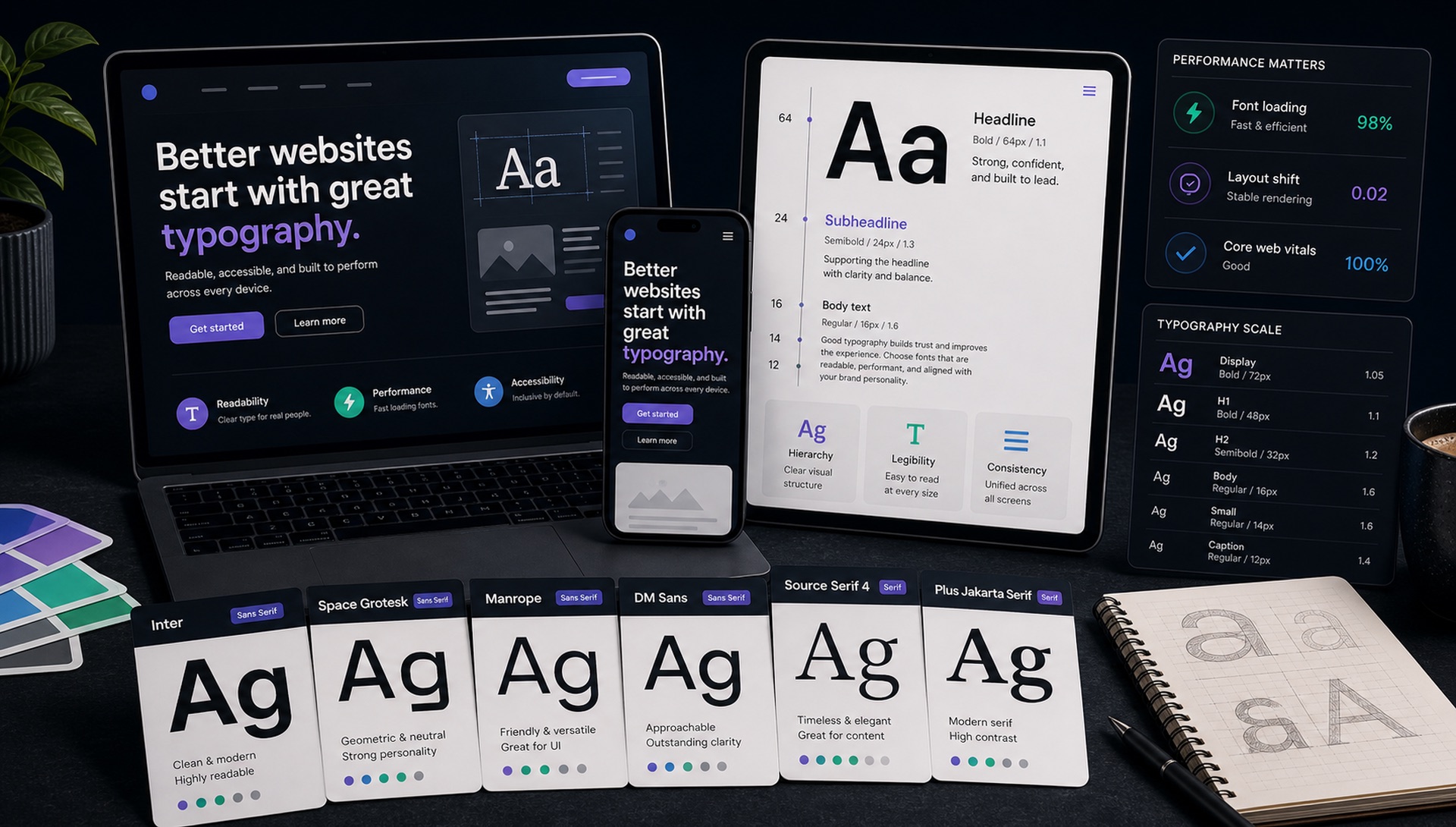
After analysing thousands of high-performing websites and testing font rendering across all major devices and operating systems, here are the 20 best web fonts for 2025. All free options are OFL-licensed and available to download directly from FontFinder.
Best for UI & Interfaces
1. Inter — The Standard
Designed by Rasmus Andersson specifically for digital interfaces, Inter is the most widely used web font in the world. Optimised for sub-pixel rendering, variable weight axis, legible at 11px. There's a reason every design system uses it.
2. Geist — The New Challenger
Vercel's open-source system font. Geometric but with humanist corrections, it's precise without being cold. Growing rapidly in adoption among developer-focused products.
3. DM Sans — The Safe Choice
Designed by Colophon Foundry, DM Sans balances geometric construction with humanist proportions beautifully. Works for UI, marketing copy, and editorial content equally well.
4. Plus Jakarta Sans — The Personality Pick
More characterful than Inter but equally functional. Distinctive enough to stand out while neutral enough to never distract.
Best for Editorial & Marketing
5. Bricolage Grotesque — The Headline Star
Wide, expressive display grotesque with a variable weight axis. Makes homepage headlines sing. Not designed for body text — use it at 32px and above.
6. Fraunces — The Serif of the Moment
Optical size variable serif that looks different and extraordinary at different sizes. The "Soft" axis gives it a warmth that most serifs lack.
7. Lora — The Reading Serif
Contemporary brush-stroke serif optimised for screen reading. Perfect for blogs, articles, and editorial content. Pairs with everything.
8. Playfair Display — The Premium Serif
High-contrast display serif with extraordinary elegance. For luxury brands, premium pricing pages, and editorial headers where impact is paramount.
Best for Content & Body Text
9. Source Serif 4 — The Adobe Classic
Adobe's open-source reading serif. Extremely legible at small sizes with optical size adjustments built in. The best purely functional serif available for free.
10. Nunito — The Friendly Sans
Rounded terminals make text approachable and friendly. Consumer apps and services targeting general audiences love Nunito for its warmth.
11. Outfit — The Startup Choice
Simple, clean, modern. Currently used by hundreds of venture-backed startups. Works at all sizes and weights without issues.
12. Work Sans — The Professional
Screen-optimised grotesque with excellent readability. The safe choice for professional services — legal, financial, consulting.
Specialty & Niche Use Cases
13. Space Grotesk — For Tech Brands
Quirky proportions give it personality. The go-to for developer tools and technical SaaS.
14. JetBrains Mono — For Code
Best monospace for code display in documentation and developer-focused sites. Ligatures, clear disambiguation of similar characters, excellent at all common code preview sizes.
15. Josefin Sans — For Fashion & Beauty
Thin geometric uppercase works beautifully for fashion brands wanting elegance without serif formality.
16. Oswald — For Sports & Entertainment
Condensed grotesque with strong vertical rhythm. High readability at small sizes makes it useful for dense information display in sports contexts.
17. Syne — For Creative Agencies
Bold personality in the heavy weights with quirky proportions. Creative studios and agencies use it to signal unconventionality.
18. Cormorant Garamond — For Luxury
Ultra-refined high-contrast editorial serif. Best web font for luxury goods, high fashion, and prestige experiences.
19. Raleway — For Elegant Minimalism
Variable weight from hairline to ultra-bold. The thin weight at large sizes creates a distinctive lightness that few sans-serifs can match.
20. Merriweather — For Long Reading
Specifically designed for screen reading at all sizes. Strong serifs, large x-height, moderate contrast — the optimal combination for long-form content.
How to Choose From This List
Twenty options is useful as a reference and paralysing as a decision. Narrow it with four questions, in this order:
- What is the smallest size this font has to survive? If you have 12px table labels, you need a large x-height and open apertures — Inter, Work Sans, or Source Serif. High-contrast display faces are eliminated immediately.
- How much text will people actually read? A documentation site needs a reading face (Lora, Merriweather, Source Serif). A landing page needs a face with presence (Bricolage Grotesque, Syne, Fraunces).
- What languages must it cover? Many characterful display faces are Latin-only. If you will ever localise into Greek, Cyrillic, or Vietnamese, check the glyph coverage before you fall in love.
- Does it ship as a variable font? If yes, you get the whole weight range in one file. This is usually worth more than a marginal preference between two similar faces.
Premium Fonts Worth the Money
The free options above are genuinely excellent, and most projects never need to go beyond them. A few situations justify a paid licence:
- GT Walsheim — warm geometric sans with real personality. Widely used in consumer brand work.
- Söhne — a modern reinterpretation of Akzidenz-Grotesk. Neutral without feeling generic, which is a hard combination to buy.
- Tiempos Text — a contemporary reading serif that holds up at small sizes better than most free alternatives.
- Untitled Sans — deliberately unremarkable in the best way. Excellent for design systems where the type should recede.
- Signifier — a high-contrast serif with genuine editorial weight for brands that need gravitas.
Web licences are typically banded by monthly pageviews, so budget against your actual traffic rather than the headline price. And check whether the licence covers logo embedding separately — many do not.
Performance: What These Fonts Actually Cost You
Font choice is a performance decision as much as an aesthetic one. Some rules that hold across all twenty options:
- A variable font beats static weights once you use three or more weights. Below that, static files are usually smaller.
- WOFF2 only. Every browser in current use supports it. Shipping TTF or WOFF fallbacks is wasted bandwidth.
- Budget 150KB total for the whole type system. Most of this list fits comfortably inside that.
- Self-host if you have EU visitors. It is faster (browser caches are partitioned per site now, so the shared-cache argument is dead) and it sidesteps the GDPR question around Google-hosted fonts entirely.
- Override fallback metrics with
size-adjustandascent-overrideso the swap does not shift your layout.
Combinations From This List That Work
- Bricolage Grotesque + Inter — expressive headlines over a neutral, workmanlike body. The current default for SaaS.
- Fraunces + Outfit — warm optical serif over a clean sans. Good for consumer products that want personality without whimsy.
- Playfair Display + Source Sans — the classic editorial pairing. Reliable and hard to get wrong.
- Space Grotesk + JetBrains Mono — for developer tools where code samples are first-class content.
- Cormorant Garamond + Raleway — luxury and fashion. High contrast against geometric restraint.
- DM Sans alone, at three weights — when you want one family to do everything. Perfectly professional, and the lightest option on this page.
Seen a site using something not on this list? Screenshot it and run it through FontFinder — identifying fonts in the wild is the fastest way to build a personal reference library of combinations that actually work.