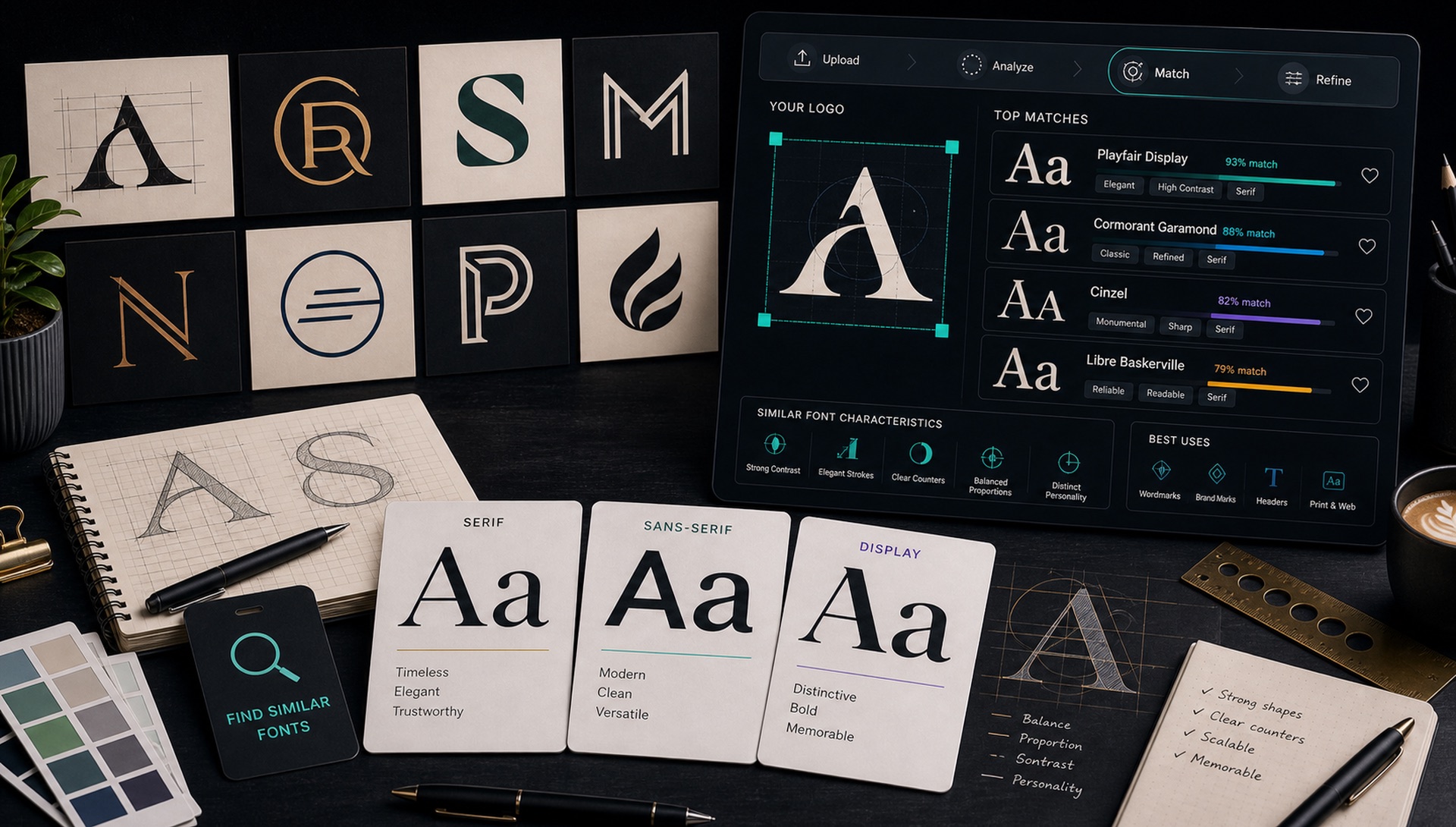
The best logo fonts are memorable, readable, and flexible enough to survive small sizes, social icons, packaging, and ads. You do not always need the exact font from a reference logo; often you need a similar font with the same personality and a license that fits your project.
Geometric sans
Clean, modern, tech-friendly, and easy to scale.
Editorial serif
Premium, fashion-oriented, and expressive.
Rounded sans
Friendly, approachable, and good for consumer brands.
Display
Distinctive for short names, but test readability carefully.
What Makes a Good Logo Font?
A logo font needs clear shapes, strong spacing, and enough character to be recognizable. It should work in black and white, at small sizes, and in both digital and print contexts. Avoid fonts that only look good in one large preview.
Three tests eliminate most weak candidates quickly. Shrink the wordmark to 32 pixels wide — favicon size — and see whether it still reads; fine hairlines and tight counters clog up first. Render it in flat black with no gradient or shadow, because embroidery, engraving and single-colour print will strip those away anyway. And print it at a couple of centimetres on paper, since screen rendering is forgiving in ways that ink is not.
Matching the Style to the Category
Each of the four styles above carries built-in associations, and working with them is easier than working against them.
- Geometric sans — circular bowls and even strokes read as modern, rational and efficient. The default for technology, finance and B2B software. The risk is anonymity: this is the most crowded category by a wide margin.
- Editorial serif — high contrast between thick and thin strokes reads as premium, established and considered. Strong for fashion, publishing, hospitality and professional services. The risk is fragility at small sizes.
- Rounded sans — softened terminals read as friendly and low-stakes. Suited to consumer apps, healthcare, education and children's products. The risk is reading as unserious where authority matters.
- Display — the most memorable and the least flexible. Viable for short names where the mark is the whole identity; it fails as soon as you need supporting text in the same family.
How to Find a Similar Logo Font
Upload the logo or wordmark to FontFinder and crop only the lettering. Compare the top matches by category, width, weight, terminal shape, and spacing. If the logo uses custom lettering, choose the closest usable font rather than forcing an exact match.
When your top results all sit at similar confidence and none looks quite right, that is the signature of custom or modified lettering rather than a failed search. It is worth knowing that many famous logotypes — Coca-Cola, Chanel, Gucci among them — are drawn artwork, not type set in any font. A logotype only ever has to spell one word, so designers optimise every curve for that word in a way no general-purpose typeface can match.
Reading Letterforms Like a Designer
Once an exact match is off the table, the useful skill is naming what you actually like about the reference. Five attributes account for most of the impression:
- Skeleton — is the underlying structure geometric (a near-circular O, single-storey a) or humanist (a slightly oval O, double-storey a)?
- Contrast — how much do stroke widths vary between the thick and thin parts of a curve?
- Aperture — do letters like c, e and s open outward or curl closed?
- Terminals — are stroke ends cut horizontally, cut at an angle, or rounded?
- Proportion — how tall is the x-height relative to the capitals, and how wide are the letters overall?
A font that matches four of those five will read as the same idea to everyone except a typographer — and it is a far better outcome than an exact match you are not licensed to use.
Test the Brand Name, Not Just the Sample
Type your actual brand name in each candidate font. Some fonts look great in a specimen but awkward with certain letter combinations. Pay attention to repeated letters, diagonals, punctuation, and numbers.
Specific pairs cause most of the trouble: rn can read as m at small sizes, capital I and lowercase l are identical in many grotesques, and diagonal pairs such as VA or AV often need manual kerning. Double letters expose uneven spacing immediately. If your name contains an ampersand, a hyphen or a numeral, check those too — they are frequently the least carefully drawn glyphs in a free family.
Check Logo Licensing
Not every font license allows logo use, trademark use, app embedding, or resale products. Before presenting a final logo, confirm the license terms and keep a link to the source in your project notes.
The SIL Open Font License is the safe default: it permits commercial use, logo use, trademark registration, modification and embedding. What it forbids is selling the font files themselves. Watch for the categories that look free but are not — "free for personal use" excludes commercial work entirely, and demo weights from commercial foundries are usually evaluation-only. Archive a copy of the license with your project files, because the question always resurfaces months later.
One further distinction: the typeface and the trademark are separate things. Setting your own name in Futura is entirely legitimate even though Nike's wordmark uses it. What you cannot do is produce a mark a consumer might confuse with an existing brand — and no font license changes that.
Quick action: Upload a clean screenshot or photo to FontFinder, crop around one font style, and compare the ranked matches with your real text before you choose a license.
Final Advice
Use FontFinder to create a shortlist, then judge the fonts in real logo context. The best choice is the one that matches the mood, works at every size, and can be used legally in the brand.
Finish by living with the top two for a day before deciding. Novelty fades quickly, and the option that felt most exciting at first viewing is frequently the one that dates first. Careful optical kerning on a well-chosen free typeface will outperform an expensive font used at default settings almost every time — craft in application is visible to users, and provenance is not.