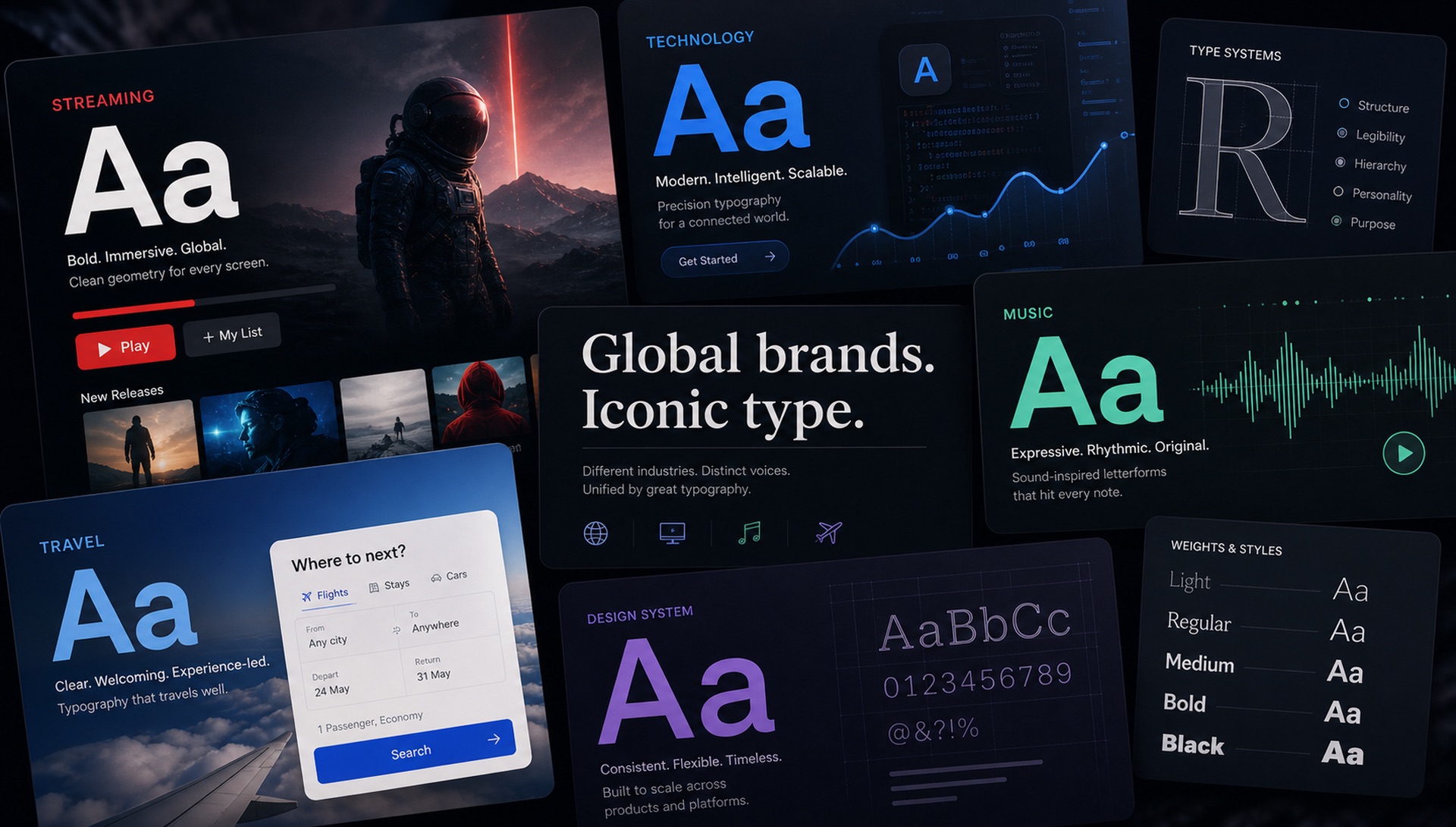
The world's most valuable consumer brands invest millions in typography. Here's exactly what fonts they use — and the strategic thinking behind each choice.
Netflix — Netflix Sans
Netflix uses a custom typeface called Netflix Sans, designed in partnership with type foundry Dalton Maag. Before commissioning the custom font, Netflix used Gotham — and the switch saved them millions annually in licensing fees.
Netflix Sans is a geometric sans with slight humanist details. The custom letterforms help distinguish Netflix's visual identity on every screen globally. The typeface works across all writing systems supported by Netflix.
Free alternative: Nunito or DM Sans capture a similar approachable geometric quality.
Apple — SF Pro (San Francisco)
Apple uses San Francisco (SF) — a typeface they designed in-house and never licensed externally. SF Pro is the system font for macOS, iOS, iPadOS, watchOS, and tvOS. It has been precisely optimised for each display technology Apple uses.
Before SF, Apple used Helvetica Neue. The switch to a custom font gave Apple greater control over optical sizing — the ability to automatically adjust letterform details based on the size at which text renders.
Free alternative: Inter is the closest widely-available approximation to San Francisco's rational, neutral character.
Spotify — Circular
Spotify's primary typeface is Circular, designed by Lineto. It's a geometric sans with rounded terminals that give it an approachable, friendly quality — appropriate for a brand that centres around the emotional experience of music.
The Circular family includes multiple weights from Book to Bold, giving Spotify's design system flexibility from delicate playlist captions to bold artist names.
Free alternative: Nunito or Poppins share Circular's rounded geometric personality.
Airbnb — Cereal
Airbnb commissioned the Cereal typeface from type foundry Dalton Maag (the same studio that made Netflix Sans). Cereal is a warm geometric sans designed to be both distinctive and globally accessible, working across Latin, Cyrillic, Greek, and Arabic scripts.
The name "Cereal" reflects Airbnb's founding story — the company famously sold custom cereal boxes to fund its early growth.
Free alternative: Plus Jakarta Sans or Outfit share Cereal's warm, rounded sans-serif personality.
The Economics Behind the Decision
Custom typefaces look like a vanity purchase until you examine how desktop and app font licensing is actually priced. Commercial licenses commonly scale on two axes: the number of employees with the font installed, and the monthly application or web traffic it serves. For a company with thousands of staff and hundreds of millions of monthly users, both multipliers are enormous, and the fee recurs every year.
Commissioning a typeface is a large one-time cost — typically a six-figure engagement with a foundry, spread across a year or more of design and production. Netflix's move away from Gotham is the standard example precisely because the arithmetic is so stark: past a certain scale, the fixed cost of owning a typeface is smaller than the recurring cost of renting one, and it stops growing as the company grows.
There is a control argument as well. A licensed typeface is a dependency. The foundry sets the terms, decides what scripts to support, and may or may not extend the family in the direction you need. Owning the source files means you can add Devanagari when you launch in India, or add a heavier display weight when the marketing team asks, on your own schedule.
What These Four Choices Have in Common
Look past the individual names and the same brief appears four times. Every one of these typefaces is a geometric sans with humanist softening — circular bowls, open apertures, low stroke contrast, and terminals cut to feel approachable rather than severe. None of them chose a serif, a condensed grotesque, or anything with strong personality.
That convergence is not a lack of imagination. These are consumer brands whose type has to work at eight pixels in a phone status bar and at eight metres on a billboard, across dozens of writing systems, in the hands of thousands of people who are not designers. Neutrality is the requirement. The brand personality is carried by colour, photography, motion and tone of voice, and the typeface is asked to stay legible and get out of the way.
The practical lesson for a smaller brand is the inverse. You are not operating at that scale, which means you can afford far more typographic character than any of these four companies can. Distinctiveness is available to you precisely because you do not have their constraints.
How to Use the Free Alternatives Honestly
A close free alternative gets you the same feeling, not the same font, and the difference matters legally. Inter is not San Francisco; Nunito is not Circular. Typeface designs themselves are generally not protected by copyright in the United States, but the font software is, and the names are trademarks. Substituting a similar OFL font is entirely legitimate. Extracting SF Pro from macOS and shipping it on your website is not — Apple's license restricts it to development for Apple platforms.
The safe pattern is straightforward: identify what you like, understand why it works, then choose a properly licensed font that shares those qualities. Judge candidates on the specific attributes that created the impression — bowl shape, aperture, x-height, terminal treatment — rather than on overall vibe.
Key Insight: Custom vs Licensed
All four of these brands either commissioned custom typefaces or license exclusive fonts. For companies at this scale, a distinctive typographic identity is worth the investment. For everyone else, the free alternatives listed above deliver extraordinary quality — and with FontFinder, you can identify a candidate from a screenshot and compare it against the free families in Browse before committing.