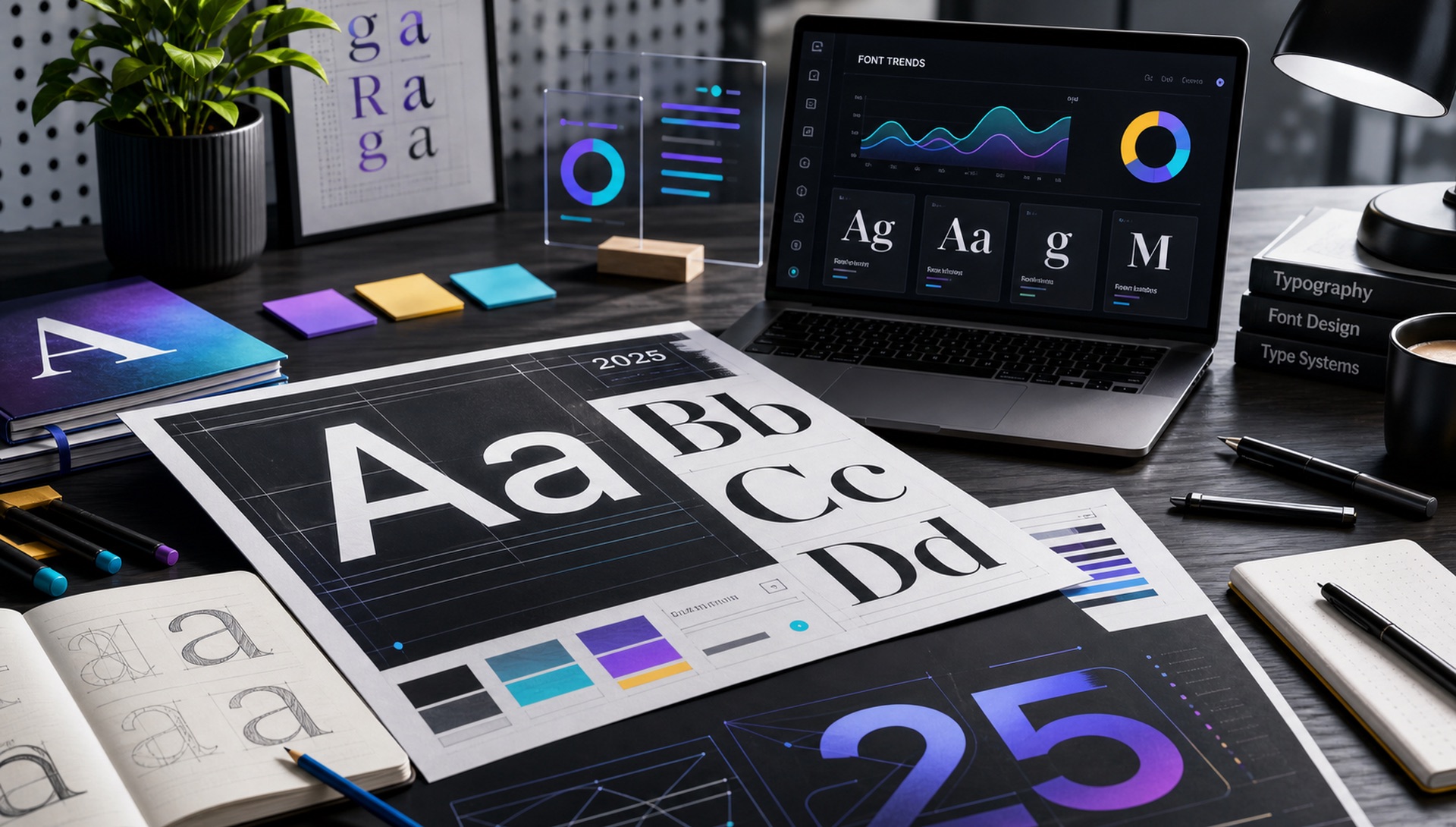
Every year, typography trends shift. Designers move on, new typefaces emerge, and old favourites either cement their legacy or fade into obscurity. Drawing on the fonts most frequently searched through FontFinder, alongside public release data from Google Fonts and the open-source type community, here are the typefaces that defined 2025 — and, more usefully, why each one earned its place.
The Top 10 Most Identified Fonts
These are the fonts users most often bring to FontFinder for identification. Note what they have in common: nine of the ten are free under the Open Font License, and seven ship as variable fonts.
- Inter — Still the undisputed king of UI design. Rational, neutral, supremely legible.
- Bricolage Grotesque — The breakout star of 2024 continues its dominance into 2025.
- Geist — Vercel's open-source system font has taken the SaaS world by storm.
- Playfair Display — Editorial serif making a strong comeback in luxury branding.
- DM Sans — Clean, modern, versatile — and completely free.
- Syne — Quirky geometric display font beloved by creative agencies.
- Outfit — Gaining massive traction in startup landing pages.
- Lora — The go-to serif for long-form reading on the web.
- Space Grotesk — Slightly quirky grotesque for tech-forward brands.
- Libre Franklin — A solid workhorse that never goes out of style.
The Biggest Trend: Variable Fonts Go Mainstream
2025 is the year variable fonts finally went fully mainstream. Fonts like Bricolage Grotesque and Recursive — which ship as a single file covering all weights — are dominating design systems. The benefits are clear: smaller file sizes, infinite stylistic range, and animations between weights that weren't possible before.
The shift is easiest to see in the numbers a developer actually cares about. Loading Roboto Thin, Light, Regular, Medium, Bold and Black as separate static files means six HTTP requests and roughly 400KB of woff2. The variable equivalent is one request and roughly 180KB, and it gives you every weight in between as a bonus. On a slow mobile connection, that difference shows up directly in Largest Contentful Paint.
The second-order effect matters more than the file size. When intermediate weights are free, designers stop treating weight as six fixed steps and start treating it as a continuous dimension. Interfaces built in 2025 increasingly use weight 450 for body text and 550 for emphasis — values that simply did not exist in the static era, and which produce noticeably more even typographic colour on screen.
The Serif Revival
After years of sans-serif dominance, serifs are back — but in a new form. We're seeing editorial serifs like Playfair Display and Cormorant appearing in tech and SaaS contexts that would have been unthinkable five years ago. The contrast between a sharp geometric sans for UI and a flowing editorial serif for headlines creates a visual sophistication that resonates with premium brand positioning.
There is a practical reason behind the aesthetic one. High-contrast serifs used to be a liability on screen: at 1x pixel density, hairline strokes either disappeared or turned muddy grey. Widespread high-DPI displays removed that constraint. A typeface like Fraunces, with an optical size axis that thickens hairlines automatically at small sizes, is designed for exactly this environment.
The pattern to copy is restraint. The serif appears in the headline and almost nowhere else — not in navigation, not in buttons, not in body copy. It carries the brand voice for one or two lines per screen, and a neutral sans does the functional work underneath.
What's Falling Out of Fashion
Helvetica and Arial are declining as primary brand fonts. Futura is still respected but feels dated in digital contexts. And Gotham — the font of a generation of political campaigns and sports branding — is being retired by brands eager to distinguish themselves.
None of these are bad typefaces. The problem is saturation. Gotham was so thoroughly adopted between roughly 2008 and 2016 that it now carries a date stamp; a wordmark set in it reads as a brand that last refreshed its identity a decade ago. Helvetica has the opposite problem — it is so neutral and so ubiquitous that it communicates almost nothing, which is fine for signage and weak for a brand trying to be remembered.
Also declining: the ultra-thin weights that dominated the mid-2010s. Weight 100 and 200 at body sizes fail WCAG contrast expectations in practice, are difficult to read on low-quality displays, and disappear entirely when printed. Accessibility review has quietly killed a whole aesthetic.
How to Use a Trend List Without Looking Dated
The risk of any list like this one is that following it produces the exact sameness it describes. A few ways to use it well:
- Borrow the structure, not the font. The winning pattern of 2025 is "one expressive display face plus one neutral workhorse." That structure will outlive every specific name on this list.
- Check the letters in your own name. A typeface that looks superb in a specimen can fall apart on the specific letter combinations in your brand. Repeated letters, diagonals, and numerals are where fonts break.
- Prefer breadth over novelty. A family with real italics, tabular figures, and a wide language range will serve you for years. A display font with 200 glyphs and no italic will not.
- Verify the license before you commit. OFL permits commercial and logo use; many free-for-personal-use fonts do not. This is the single most common expensive mistake in brand work.
Key Takeaway
The best typography in 2025 is purposeful, variable, and accessible. Designers are reaching for fonts that do more with less — single variable files that cover an entire brand's needs, free OFL-licensed typefaces that perform at the level of commercial alternatives, and display fonts bold enough to make a statement without saying a word.
If you spotted a font in the wild that fits this description and want to know what it is, upload a screenshot to FontFinder and crop tightly around the lettering. You can then preview the ranked matches in your own brand name before committing to anything.