Identifying a font is the easy half of the job. The harder question arrives immediately afterwards: are you actually allowed to use it? A typeface is software, and it ships with a licence that decides where it may appear — a desktop poster, a website, a mobile app, a client logo, an ebook, a product you sell. Getting that wrong is the single most expensive mistake in brand work, because it usually surfaces after the design is printed, shipped, or trademarked.
This guide explains the licence types you will meet in practice, what each one permits, and the specific traps that catch designers. It is written for working designers rather than lawyers, and it is general information rather than legal advice — for a contract of real value, have the actual EULA read by someone qualified.
Who
How many people or machines may install and use the font file.
Where
Desktop, web, app, ebook, broadcast — each is often licensed separately.
How much
Webfont licences frequently cap monthly pageviews or domains.
What next
Whether you may modify, embed, redistribute, or trademark the result.
The Open Font License (OFL)
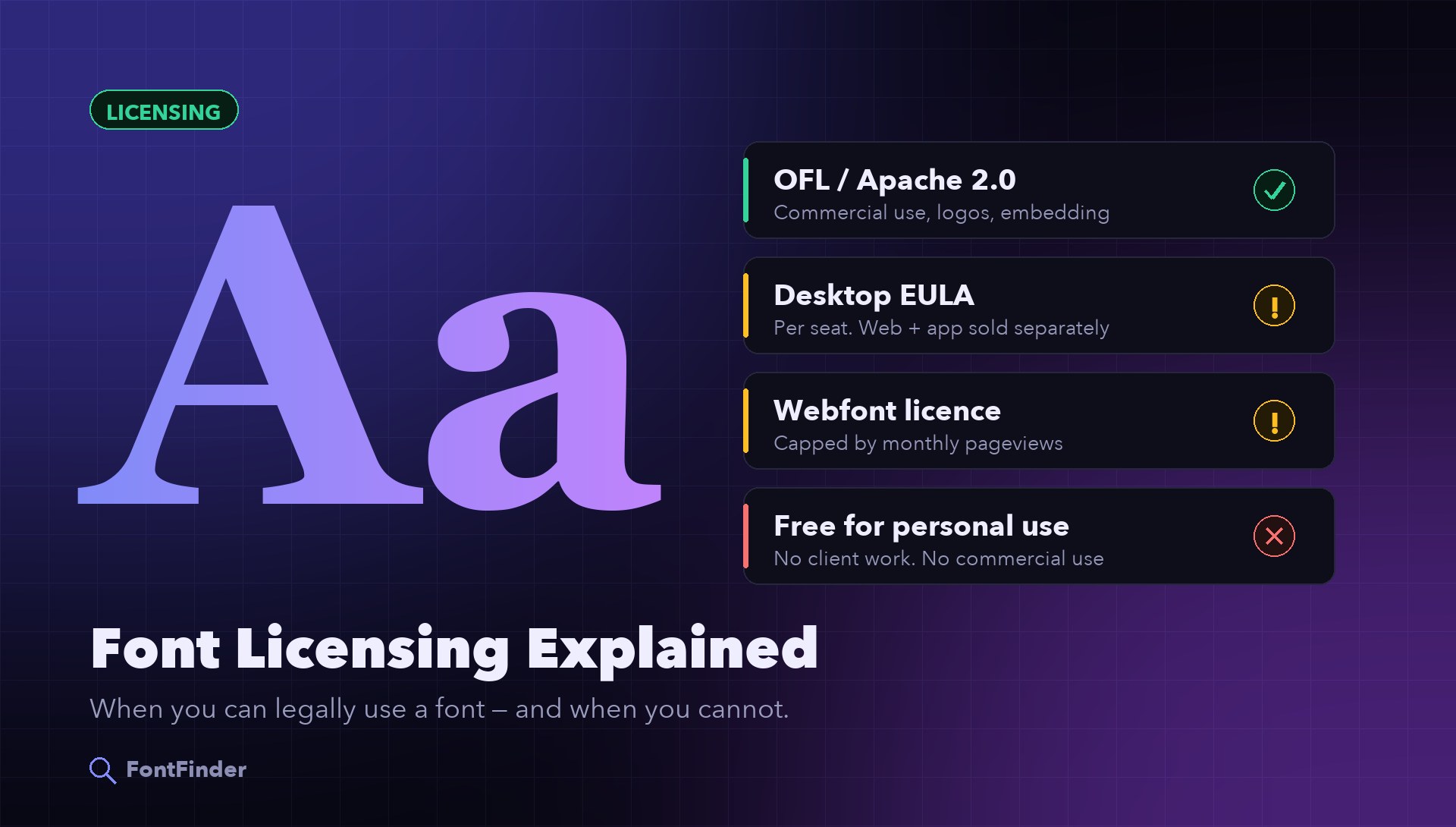
The SIL Open Font License covers the overwhelming majority of free, high-quality typefaces, including nearly everything on Google Fonts. It is deliberately permissive and it is the safest licence a designer can work under.
Under the OFL you may use the font commercially, in print and on the web, in apps and in products you sell. You may embed it in documents and software. You may modify it. You may bundle it with a paid product. There is no fee, no registration, and no pageview cap.
The OFL has three real restrictions, and they rarely affect ordinary use:
- You cannot sell the font on its own. Bundling it inside a template or app is fine; selling the font file as the product is not.
- Modified versions must be renamed if the original carries a Reserved Font Name, and must themselves remain under the OFL.
- The licence text travels with the font. If you redistribute the file, include the OFL notice.
Crucially for brand work: OFL fonts can be used in a logo, and that logo can be trademarked. The trademark protects your specific mark, not the typeface, so it takes nothing away from anyone else.
Apache 2.0 and Ubuntu Font Licence
A minority of older Google Fonts — Roboto and Open Sans among them — are licensed under Apache 2.0 rather than the OFL. For practical purposes the permissions are the same or slightly broader: commercial use, modification, and embedding are all allowed, and there is no rename requirement. Attribution requirements are mild and are satisfied by keeping the licence file with any redistributed copy.
The Ubuntu Font Licence, which covers the Ubuntu family, is similar in spirit but has its own rename-on-modification clause. If you are only using the font as shipped, none of this affects you.
Commercial Desktop Licences (the standard EULA)
When you buy a font from a foundry or a marketplace, the default purchase is a desktop licence. It permits you to install the font on a set number of computers and use it to create static artwork — posters, packaging, PDFs, images.
What it does not automatically include is the part designers most often assume:
- Website use. Serving the font as a webfont requires a separate webfont licence in almost every commercial EULA.
- App embedding. Bundling the font file inside an iOS or Android app is a distinct licence tier.
- Handing the file to a client. Sending the font to a client or a printer is redistribution. The licence is usually yours, not transferable — the client needs their own.
- Unlimited seats. Licences are typically sold per workstation. A five-person studio usually needs five seats.
Seat counting is where honest teams drift out of compliance. A licence bought for one designer gets shared into a team Dropbox, and two years later the studio is running twelve installations on a one-seat licence.
Webfont Licences and Pageview Caps
Commercial webfont licences are usually metered. The common models are a monthly pageview allowance, a fixed number of domains, or an annual subscription tied to traffic. A licence bought when a site served 10,000 views a month can be quietly breached the moment a campaign lands.
Two practical habits prevent this. First, record the cap somewhere your team will see it — a note in the design system, not a receipt in someone's inbox. Second, re-check it whenever traffic changes materially. Foundries generally handle overages by invoicing for the correct tier, which is manageable if you catch it and unpleasant if they do.
Self-hosting an OFL font sidesteps the whole category. There is no cap, no reporting, and no renewal.
"Free for Personal Use" Is Not Free
This is the most common and most costly misunderstanding in font licensing. A large share of the fonts on free download aggregators are labelled free for personal use, which means exactly what it says: you may use them for things that make no money.
Client work is commercial. A logo is commercial. A monetised YouTube channel, a product listing, a startup landing page, a T-shirt you sell, a book you publish — all commercial. Using a personal-use font in any of those requires buying the commercial licence, and foundries do pursue this, often years later when the brand has grown enough to be worth pursuing.
Aggregator sites also mislabel fonts routinely. If a font matters to a project, verify the licence at the designer's own page or the foundry's site rather than trusting the download button.
Adobe Fonts, Monotype and Subscription Libraries
Adobe Fonts is included with a Creative Cloud subscription and covers both desktop and web use for as long as the subscription is active. Logos and trademarks are permitted under Adobe's terms. The limitation is that you cannot extract and redistribute the font files, cannot embed them in an app you distribute, and lose access if the subscription lapses — which matters if a client needs to edit the artwork in five years.
Monotype Fonts and similar library subscriptions work along the same lines: broad access while you pay, restricted redistribution, and separate terms for app embedding and broadcast use.
Logos, Trademarks and Broadcast
Setting a wordmark in a typeface and then trademarking that wordmark is permitted under the OFL, Apache 2.0 and Adobe's terms. Some commercial foundries, however, require an extended or bespoke licence for trademark use, and a few charge separately for it.
Broadcast, film and large-scale out-of-home advertising are also commonly carved out into their own tiers. If the work is going on television or on a national billboard campaign, read the EULA specifically for those words.
Quick action: Upload a clean screenshot or photo to FontFinder, crop around one font style, and compare the ranked matches with your real text before you choose a license.
A Practical Pre-Publication Checklist
- Find the licence, not the download page. Locate the actual OFL.txt, EULA, or licence page for the exact font you have.
- Match the licence to every medium in the project. Desktop, web, app and ebook are four separate permissions in most commercial EULAs.
- Count your seats honestly. Include contractors and any machine with the font installed.
- Check the pageview cap if you are serving a commercial webfont, and record it where the team can see it.
- Confirm logo and trademark rights before the mark goes to registration.
- Never send font files to clients or printers unless the licence explicitly allows it. Send outlined vectors or a PDF instead.
- Keep the paperwork. Store the receipt and licence PDF with the project files, not in an inbox.
When the Licence Rules the Font Out
Sometimes you identify the font, and the licence makes it impractical — the budget will not cover the seats, or the pageview tier is wrong for the traffic. That is a normal outcome, and the fix is to find a close relative under a permissive licence rather than to use the original and hope.
If you have an image of the type you want, upload it to FontFinder and work down the ranked matches. The results flag free options, so you can shortlist candidates that are already OFL-licensed and compare them in your own wordmark before committing. Our guide to finding similar fonts covers how to judge those substitutions well.
Summary
OFL and Apache 2.0 fonts are safe for essentially any commercial use, including logos you trademark. Commercial fonts are licensed per medium and per seat, and web, app and broadcast use are usually separate purchases. "Free for personal use" excludes all client and commercial work. Verify the licence at the source before you publish, and keep the paperwork — the cost of checking is a few minutes, and the cost of not checking arrives as an invoice.
Related Guides
- How to find similar fonts — when the original is too expensive or restrictively licensed.
- Best free fonts for logos — OFL-licensed typefaces that are safe for trademark use.
- How to use Google Fonts the right way — self-hosting, performance, and why the licence is simple.
- Font finder from image — identify the typeface before you research its licence.